Kilevel
Dashboard

Language / Sprache

KILEVEL © 2026

Education

Five Quiet Months, and Then Ten Days

A team sized for the peak is idle all year; a team sized for the average loses exactly the applicants who could not get through. And an obligation other sectors do not carry: some callers are minors — and anything touching safeguarding has to leave the automation at once.

The Rule That Comes Before Everything Else

A prospective student may be fifteen. Safeguarding is not a tone of voice you ask a model to adopt, and it is not a category in a report — it is a stop condition on the running conversation that reaches a trained person. Which is why this section comes before the one about conversion rather than after it.

What a reviewer checks first
Age established
AI disclosed
Permitted topics only
Calling hours respected
Safeguarding signal seen
Script continued
auto-fail

The last field is the only one that counts. A signal that was seen and then talked past is worse than one that was never seen at all.

  • Age firstBefore anything else is asked, and as a field rather than an assumption
  • Topic boundaryWhat may be discussed is a list — everything else is a stop
  • Calling hoursSeparate, narrower hours for under-eighteens, enforced on the job
  • RoutingTo a trained person, not to the next free line

A Year That Is Mostly Two Weeks

Nothing happens for five months, then everything happens. The phone system fails in precisely the ten days a cohort is decided — and the applicant who could not get through to you gets through to somebody else.

Calls per working day
March~40
June~120
August, day one~2 400
August, day ten~900

Illustrative. No staffing plan bridges that jump, and nobody recruits for ten days.
WHAT REACHES THE BOTTOMEnrolledNOT AT THE END, AT THE SIDENever called back
The loss does not come out of the bottom, where every report looks. It leaves the side, quietly, in the shape of people nobody called back.
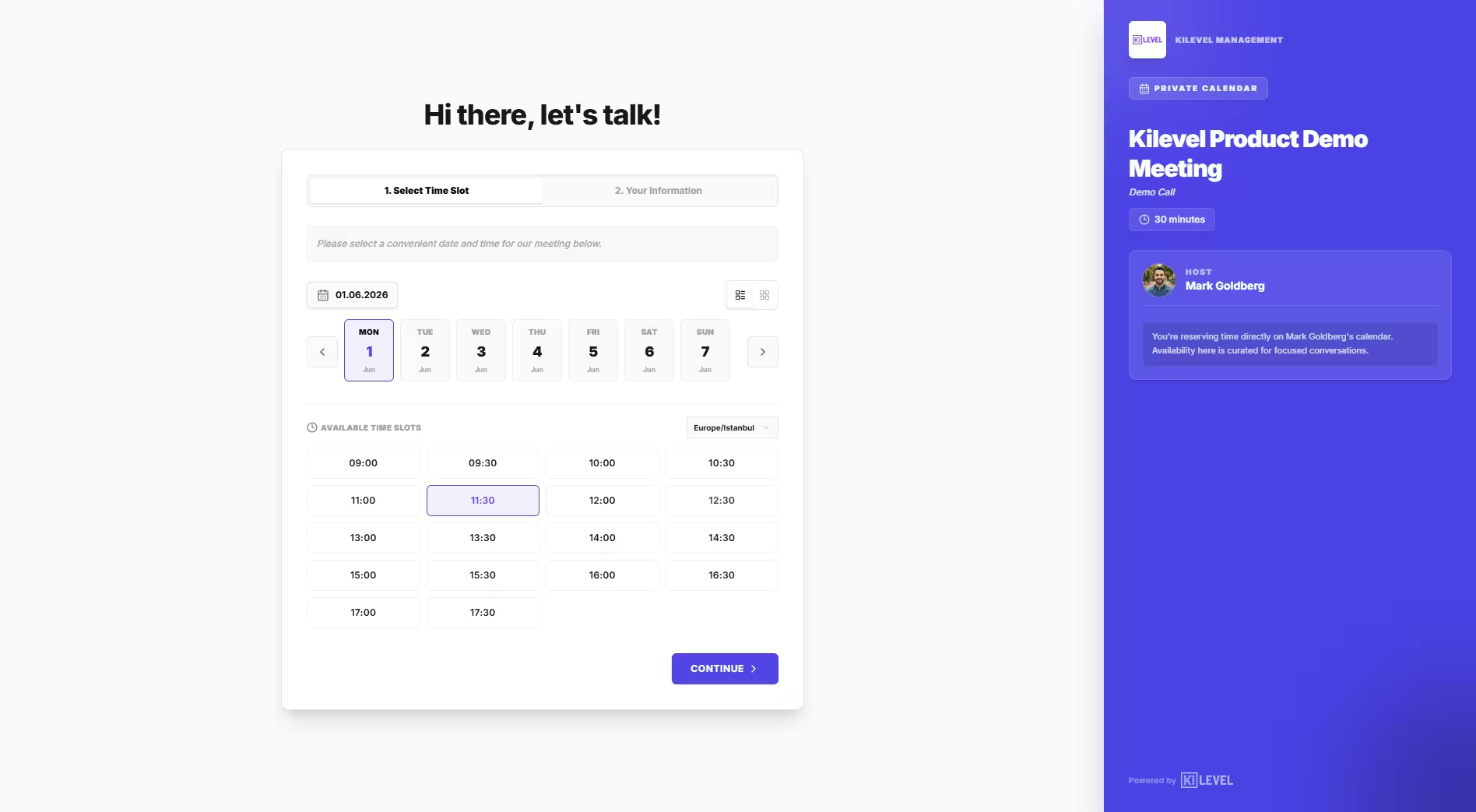
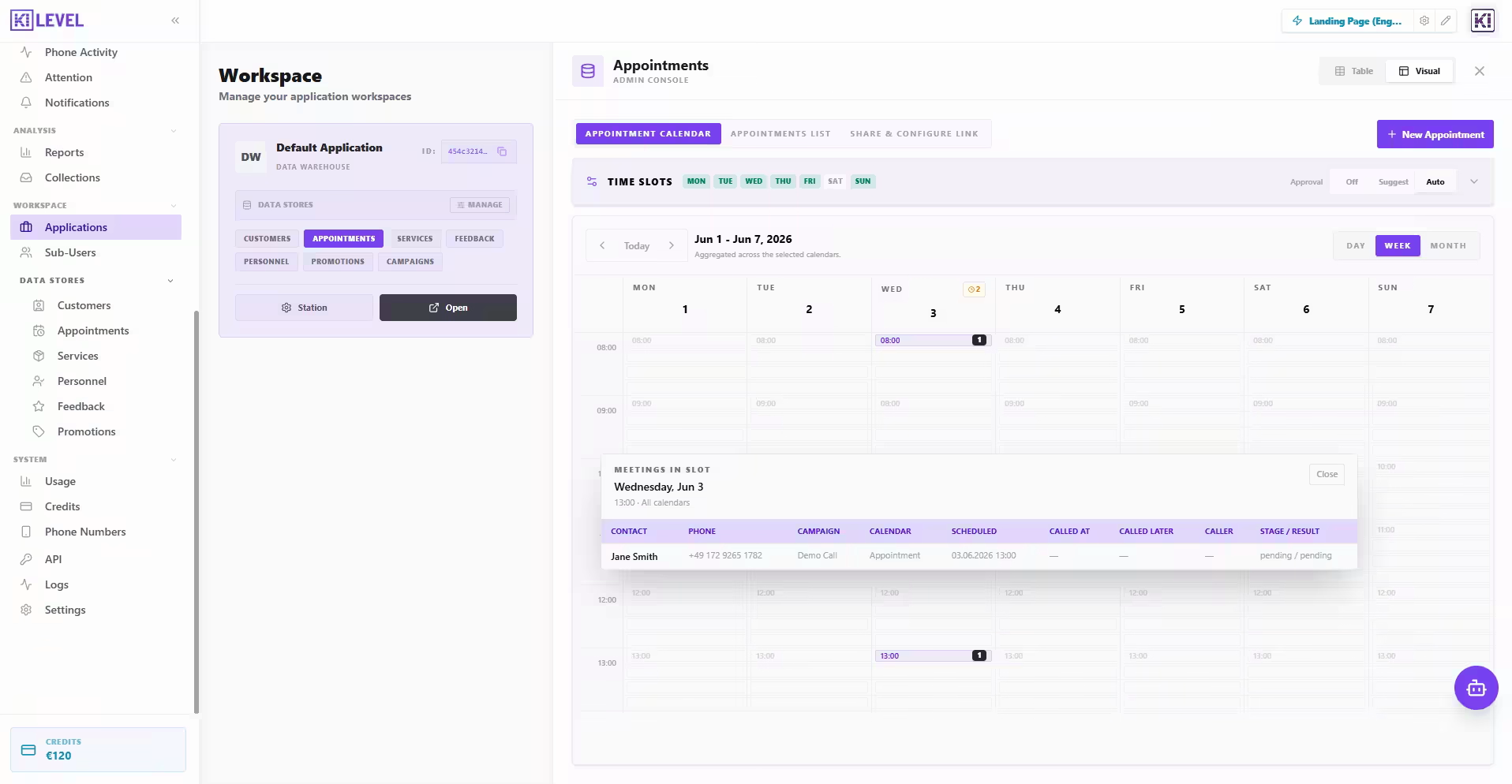
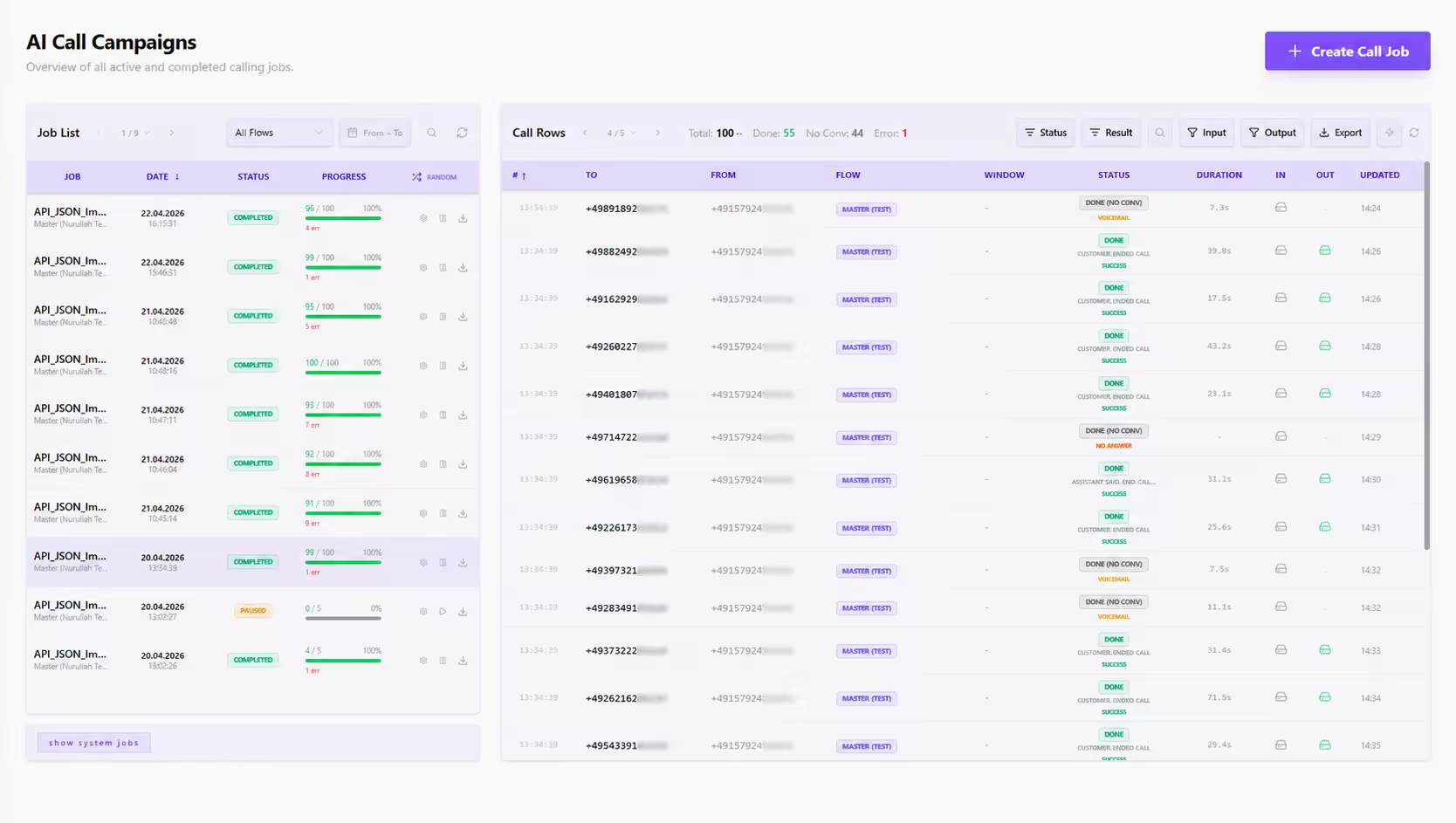
Kilevel call jobs handling an admissions peak with concurrency ceilings and calling windowsKilevel booking page showing genuine availability with capacity per slotKilevel data store showing applicant enquiries as typed rows with programme, stage and outcome
Enlarge

Two Weeks of Capacity, Then Back Down

Results day turns a quiet inbox into thousands of calls from people deciding where to spend three years. Concurrency is a ceiling you raise for a fortnight and lower again, rather than a team you cannot hire for a fortnight.

And Then the Paperwork

Between an offer and an enrolment sits a list with gaps: a reference, a transcript, a language certificate, a funding confirmation. The chase is thousands of short, identical calls — and it decides how many offers actually become enrolments.

What makes an application complete
Transcript
Reference
Language cert
ID
Funding
Accommodation
Programme
Entry route

Dashed means: still outstanding

Chased until the file is complete

The workflow knows exactly which document is missing, explains it once clearly, and switches to a message with an upload link after two attempts — until the file is complete rather than until somebody forgets.

Document missingCallSecond attemptSMS with a link

And the offer holder who went quiet

Somebody who stops replying in July is not a lost cause, they are an uncalled number. A call before the deadline asks what is actually in the way — accommodation, funding, a competing offer — and the answer is typed.

Offer, no replyCall before the deadlineBlocker?Resolved
What is countable at the end
programmeOfInterestentryRouteblockingFactorfundingStatuscompetingOfferdecisionStage

Groupable enumerations rather than free text: next year's planning starts from counts instead of impressions.

And the ones who do not live in your office hours
Languagethe conversation in theirs, the record in yours
Timezonetwelve hours ahead is still answered
Channelcall, chat, SMS, WhatsApp or email
Escalationa thread the person on shift can read
And who sets it up

Describe your programmes, the routes in and what disqualifies somebody, and the AI assistance drafts the agent, the safeguarding rule against a field that exists, the qualification schema, the chase workflows and the multilingual copy — as a reviewable list of individual edits. The one rule that has to be right before the first call is the safeguarding exit; that is exactly why it is proposed rather than quietly set.

Note on minors

Where minors are involved, separate requirements apply to consent, data processing, contact hours and safeguarding, and in many cases parental consent is required. An AI agent may support this work but must never take, assess or delay a safeguarding report. Configuring the routing to trained staff, and complying with the applicable rules, rest with the operator.

The calendar behind open days and advice appointments is under Appointment Booking, the calling machinery — ceilings, windows, retries — under Outbound, and the chase workflows under Automations.

First
The safeguarding exit

A stop condition on the call, not a category in a report

2 weeks
Instead of a year-round team

Capacity is raised for the peak and lowered again

Every
Missing document chased

Called twice, then sent a link, until the file is complete

0
Days of wait abroad

An answer in their own language, whatever your office hours

Next step

Ready to Transform Your Call Operations?

Join Europe's largest infrastructure enterprises already running their call operations on Kilevel with premium AI quality.

FAQ

Frequently Asked Questions

Everything you need to know about Kilevel.

Kilevel is a full-stack AI operations platform for businesses that communicate at scale. It unifies phone calls, WhatsApp, SMS, email, and web conversations under a single AI-native operating system, with visual workflow automation, omnichannel inbox, AI conversation analysis, and real-time operational control. From solo operators to enterprise teams, Kilevel runs autonomously across your entire communication stack.

Legacy IVRs follow rigid scripts. Chatbots handle text in isolation. Kilevel is an AI-native operations platform that handles real phone calls, WhatsApp, SMS, email, and web conversations simultaneously, with genuine contextual understanding. Agents adapt mid-conversation, book appointments, trigger follow-up automations, analyze every interaction, and hand off to humans when appropriate. The entire stack runs from a single platform: inbound queue, outbound campaigns, post-call intelligence, and operational reporting.

Yes. You can build and test your AI agent for free using our library of ready-made industry templates or by starting from scratch. Design call flows, configure channels, and connect integrations before going live. When you deploy, you pay a monthly subscription fee, which already includes a bundle of free AI minutes per month. Any usage beyond the included allowance is billed on a pay-as-you-go basis. No seats, no surprise fees.

No seats, no per-user charges. Kilevel combines a monthly subscription with usage-based pricing: each plan includes a pool of free AI minutes per month, and additional usage beyond that is billed at a per-minute rate. Building, testing, and configuring agents is free. Once live, costs scale predictably with your volume. Enterprise customers with high-volume commitments can discuss custom pricing agreements.

Most teams ship their first agent within a day. Kilevel comes with a library of industry-specific templates that cover the most common call flows and channel configurations out of the box. Pick a template, configure your agent's persona and rules, connect your tools, and deploy, no code required. Custom flows are built visually, and the AI flow assistant can generate an entire flow structure from a single descriptive sentence.

Kilevel gives your team leverage, not a replacement. AI agents absorb the volume of after-hours calls, common questions, appointment bookings and multilingual conversations, so your staff can focus on complex cases that genuinely need a human. Built-in sentiment analysis and configurable handoff triggers mean the AI always knows when to step aside.

The platform, the database and your recordings run on Google Cloud in Frankfurt, Germany, and the telephony infrastructure sits in a German data centre. Speech and language providers are used through their EU endpoints wherever the provider offers one. Where a provider processes outside the EU, that transfer runs on Standard Contractual Clauses, and every such provider is named with its processing region in our public Trust Center. An Article 28 data processing agreement applies from day one, with no separate negotiation, and we never use your data to train models.

Yes. Agents can detect a caller's language and respond accordingly, or you can configure language-specific flows per channel. This is particularly relevant for European businesses serving customers in German, French, Spanish, Dutch, and other languages alongside English, all within the same platform, without duplicating your entire agent setup.

No. The platform is designed for operators first. Flow building, agent configuration, channel setup, and integration connections are all no-code. Developers who want deeper control get a full REST API, webhooks, MCP-compatible tool discovery, and prompt-level customization, but none of it is required to run a production deployment. Non-technical teams operate Kilevel every day.

Completely. Every flow, agent behavior, escalation rule, and analysis signal is configurable, visually, without code. You define the tone, language, fallback responses, and handoff conditions. Advanced users can go further with prompt modules, templating parameters, flow templates, and a full REST API. If your workflow is unusual, Kilevel almost certainly supports it.

Complete control. You define tone, language, permitted topics, and response templates using prompt modules and templating parameters, reusable building blocks your agents draw from consistently. Escalation rules trigger human handoff based on sentiment, topic, or conversation outcome. Every configuration is fully testable in a sandbox before it touches a real customer.

You have full control over what your agent says. Define tone, language, and exact response templates. Escalation rules let you specify when a conversation gets transferred to a human, based on topic, negative sentiment, or repeated failed attempts. Everything is testable before it goes live, and you can iterate on agent behavior at any time.

Yes, and often without any setup at all. Kilevel supports MCP (Model Context Protocol), which means it can automatically discover and digest integrations from modern CRMs, ERPs, and data platforms. For everything else, there are webhooks, a REST API, and pre-built connectors. Your data flows in and out on your terms.

Both directions are fully supported. Kilevel uses MCP (Model Context Protocol) to automatically discover and integrate modern CRM and ERP systems, often with zero connector setup. In the other direction, Kilevel's REST API lets your own tech stack trigger calls, campaigns, and automations externally, and pull conversation results, analysis, and outcomes back into your systems on demand.

Yes, automatically. Kilevel scales concurrent lines dynamically, whether you're handling 10 conversations or 10,000, the infrastructure adjusts without manual intervention. The Operations Control Center gives you live visibility into concurrency, queue depth, and agent performance, so you're never operating blind at scale.

Your data sits in Frankfurt, Germany: platform, database and recordings on Google Cloud, telephony in a German data centre. Credentials are encrypted at the column level with AES-256-GCM, every query is scoped to its owning account, sub-users carry project-specific roles, and administrative actions are written to a reviewable audit trail. We process only on your documented instructions and never train models on your data. The full subprocessor list, with the processing region of each, is published in our Trust Center.

Kilevel agents are designed to manage uncertainty without frustrating the caller. They can ask clarifying questions, offer alternate paths, or escalate to a live operator, automatically, based on rules you set. The Attention Suite enables immediate human takeover mid-conversation without any disruption to the customer experience.

Kilevel agents handle uncertainty without derailing the experience. They can ask clarifying questions, reroute the conversation along alternate paths, or escalate to a live operator, all automatically, based on configurable rules. The Attention Suite lets operators intervene instantly mid-call, taking over the conversation without the customer noticing any disruption.